Unquiet Monuments
The Boer Statues – Royal Engineers Barracks

The nature and meaning of the statues in our midst have been thrown into stark relief recently. Here is not the place to rehearse arguments regarding the pros and cons of toppling statues, but I thought it might be interesting to take a look at how relatively transient and portable some statues are, and how this can challenge our perceptions of permanence. I had an interesting conversation with someone who had signed a petition for the removal of Kitchener’s statue in Chatham, “Where exactly is it?” they asked me, reinforcing Robert Musil’s observation that “the most striking thing about monuments is that you don’t see them”. Anthropologist Michael Taussig writing presciently in 1999 improved on Musil’s idea when he suggested that when statues are defaced “the statue moves from an excess of invisibility to an excess of visibility”.
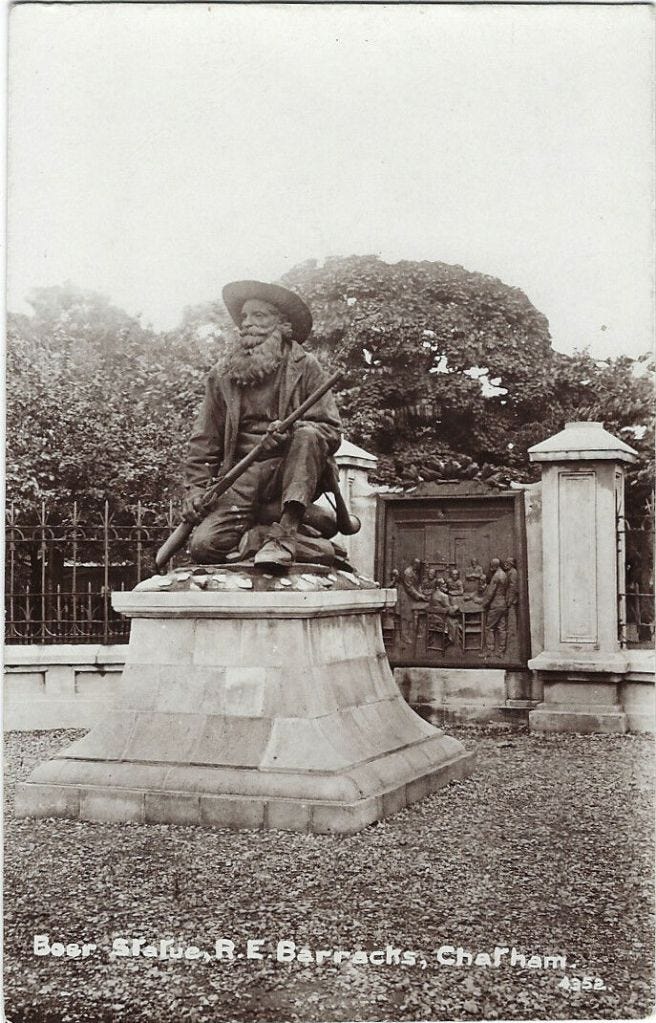
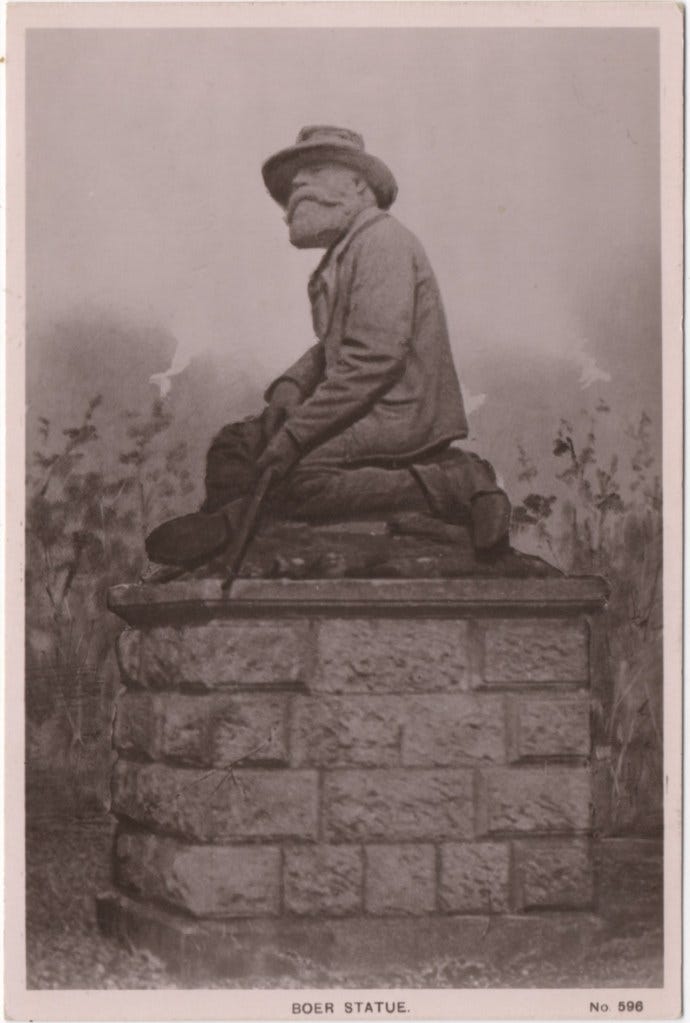
Recently, as I was looking through a hugely impressive collection of local Medway postcards, I came across one that caused me to have a second look. It was a statue of a crouched and weary Boer soldier, captioned ‘Boer Statue, R.E. Barracks, Chatham’. I don’t know a great deal about military memorials, but this statue seemed curious in that what it was depicting was a defeated enemy, not as a fierce adversary, but with such a sympathetic intent. It seems relatively unusual to depict one’s enemy in statuary form when usually these depictions are reserved for military leaders in poses of proud martial conquest or more gentle depictions of ordinary soldiers at rest on war memorials. My interest was piqued, I performed the usual searches online and picked up postcards of two other statues depicting Boer Voortrekkers. The labels on these cards tell us that the statues were to be found at the Royal Engineers Barracks in Chatham.
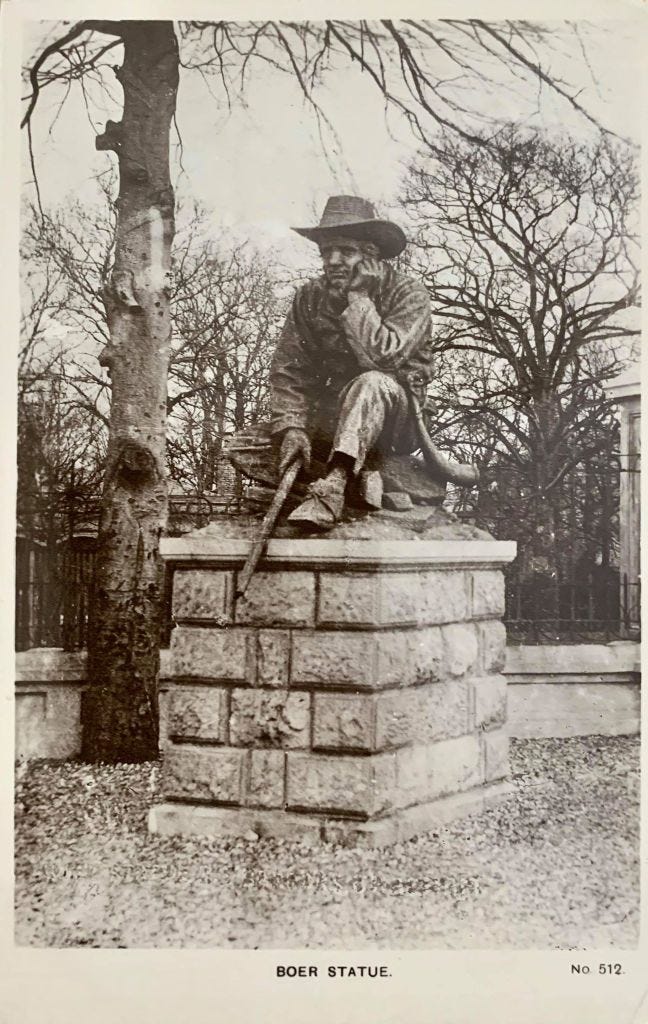
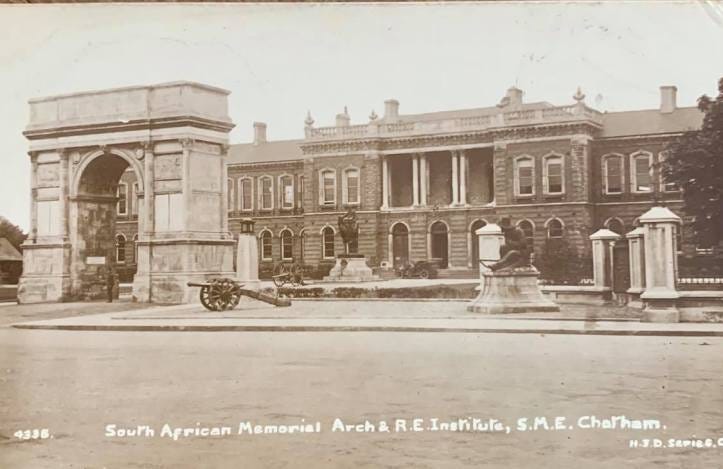
It was on this same parade square that the Boer War Memorial Arch could be found, designed by the architect Edward Ingress Bell and built of Portland stone, with the names of the fallen of the Anglo-Boer War of 1899-1902, inscribed on Istrian marble. It had been financed by raising a subscription from the officers of the Royal Engineers. The Memorial Arch was unveiled by King Edward VII on the 26th of July 1905. The bronze Voortrekker statues had been given to Lord Kitchener in 1902 by a Pretoria businessman, Samuel Marks, who had originally commissioned them from the sculptor Anton van Wouw in 1899 as part of a proposed monument to President Kruger. In a letter to Sir Thomas Fraser dated the 21st May 1902, Kitchener noted that he had “obtained four bronze statues of Boers, rather larger than life-size… Though I have not seen the figures, I am told they are very good representations of the different types of Boers”. After the Inspector General of Fortifications sought agreement from The Duke of Cambridge, the Engineers’ Colonel, the gift was accepted. The statues were described as “Two Voortrekker Boers in old National costume, each with an “ou sannah” (flint-lock) rifle; both in sitting position” and “Two present-day Boers each with a Martini rifle; both sitting.”
The inclusion of the statues in the memorial caused some disquiet among the ranks. On the 19th December 1902, a letter was sent to Kitchener noting that “there is a good deal of feeling against… the figures being associated with such a Memorial.” Kitchener’s reply dated the 11th January 1903 notes his regret at the turn of events “I am sorry the Corps have taken the view of the Memorial you describe. Of course, any arrangement you think would be best would be entirely agreed on by me”. He did note that if they weren’t used for the memorial he would “like to consider their disposal, as my gift to the Corps was for that purpose”.
A notice appeared in The Royal Engineers Journal dated Friday the 1st May 1903, regarding a questionnaire on the status of the monument which had been circulated to 1,620 full-pay and retired officers and received 673 replies. Of these replies, 50 agreed to the proposal but took exception to the Boer figures, 20 were indifferent and another 56 were directly adverse[sic] to the proposal. Discussions continued and a report of the Annual Meeting of the Corps in the REJ of the 1st July 1903 noted that “…to make such use of what had been intended for Mr. Kruger’s statue would cause the keenest feelings of resentment among our new fellow-subjects”. As well as concerns for the feelings of the Boer people, there were concerns that “if you use these statues in the Memorial to our dead and put them in the most prominent portions of it… it will always be considered that it is mainly a memorial to the Boers.”
The controversy continued into October 1903, when the committee set up to decide on the figures voted against their inclusion in the memorial noting “Those who are wholeheartedly in favour of the inclusion of the Boer figures can only console themselves for their exclusion by condemning the apathy of the majority of their brother officers.” The exclusion of the statues led to one T. Fraser withdrawing his subscription to the monument, noting that only one officer who had served in South Africa had been included on the Committee. The statues remained in the barracks, but not immediately connected to the completed memorial, as one author described it they were ‘relegated to a far-flung corner of the parade ground to ensure the memorial should remain unsullied by any symbolic association”.’
In 1913 two of the statues were relocated to Kitchener’s estate at Broome Park near Canterbury, where they remained until 1921, by which time the political situation had changed sufficiently that when General Smuts asked for the return of all four, it was considered politically expedient to do so. By this time Kitchener had died, and his family acquiesced to their return as a means of “cementing the relationship between South Africa and Great Britain”, and so the statues were placed at the disposal of the King, in his role as Colonel in Chief of the Engineers. The statues were officially returned to South Africa on the 30th January 1921, and in 1925, on the centenary of Kruger’s birth they were included at the base of his statue, also sculpted by Anton van Wouw, outside Praetoria Station. On the 10th October 1954, this memorial was moved to Church Square, Pretoria/Tshwane, where it remains today.
The unhappy story of these statues continues, however. In 2015 these statues became embroiled in the controversy that coalesced around the Rhodes Must Fall movement when they were defaced with green paint by protestors. This led to a mobilisation of various political factions, from the Marxist ‘Economic Freedom Fighters’ to the neo-Nazis of the Afrikaner Weerstandsbeweging (AWB) who demonstrated and confronted each other about the meaning and value of the memorial in post-apartheid South Africa. Controversy over this memorial continues to this day, with paint thrown over them as part of the Black Lives Matter protests last month as a comment on Kruger’s record as a slave-owner.
The history of these weary and defeated statues offers us a fascinating record of the changing meanings attributed to the monuments in our midst, as well as their portability. One often thinks of statues as immovable objects, but these have travelled the world as war booty, war memorial, garden ornaments, and finally as a monument to the founding of a nation, leading to a discussion about what that nation represents.